
ChemInfoPlus
Chemoinformatics and AI for Molecular Sciences
Chemoinformatics BIP 2026 introduces molecular data, FAIR principles, QSAR modelling, and practical tools for drug and material design.
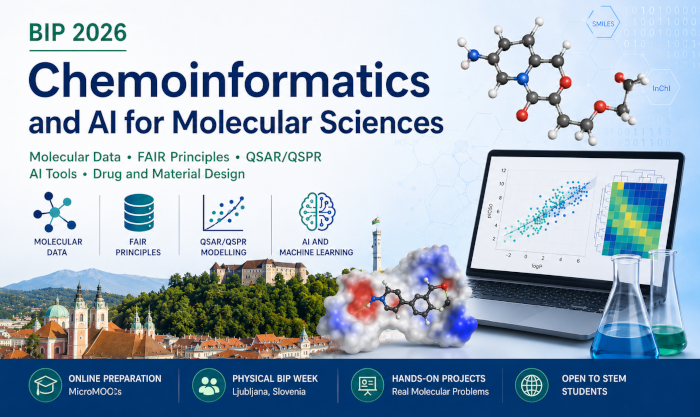
Blended Intensive Programme 2026
Chemoinformatics and AI for Molecular Sciences
This online microMOOC prepares students for the physical BIP week in Ljubljana.
Students will learn how molecular data, FAIR principles, descriptors, fingerprints, QSAR/QSPR models and AI tools are used in modern chemistry, drug discovery and material design.
Online microMOOC + physical BIP week
BSc, MSc and PhD students
RDKit, Orange, Jupyter, open resources
About This Course
Chemoinformatics BIP 2026: Molecular Data, FAIR Principles and AI Applications is an online preparation activity for the Blended Intensive Programme that will continue with a physical week in Ljubljana.
The course introduces students to the basic concepts of chemoinformatics and prepares them for practical work with molecular data. Students will learn how molecules can be represented as data using chemical structures, SMILES, InChI, molecular graphs, descriptors and fingerprints.
Special attention is given to data quality, FAIR data principles, molecular databases, QSAR/QSPR modelling, and the responsible use of artificial intelligence in chemistry.
The online microMOOC combines short readings, interactive SCORM activities, quizzes, Jupyter notebooks and guided examples. It prepares students for group work during the physical BIP week, where they will apply open tools to solve small molecular data problems.
Intended Learning Outcomes
After completing the online preparation and participating in the BIP activities, students will be able to:
Explain the role of chemoinformatics in modern molecular sciences.
Recognize molecular representations such as SMILES, InChI, SDF, graphs, descriptors and fingerprints.
Identify data-quality problems such as invalid structures, duplicates, salts, mixtures, missing values and inconsistent units.
Calculate and interpret molecular descriptors and fingerprints.
Explain QSAR/QSPR modelling, validation, overfitting, classification and regression.
Use guided workflows in RDKit, Orange or Jupyter for molecular data analysis.
Critically discuss limitations, applicability domain and responsible use of AI models.
Prepare a small project idea for the physical BIP week.
Requirements
This course is suitable for BSc, MSc and PhD students in chemistry, pharmacy, molecular sciences, materials science, environmental science, biology, computer science and related STEM fields.
Basic knowledge of chemistry is recommended. Previous programming experience is useful but not required. The practical activities are guided and prepared for students from different backgrounds.
Students should have access to a modern web browser and be ready to complete short online activities before the physical BIP week.
Course Staff
Črtomir Podlipnik
University of Ljubljana
Course coordinator and lecturer in physical chemistry, chemoinformatics, molecular modelling and digital tools for chemistry education.
Martin Šicho
UCT Prague
This lecturer will contribute expertise in chemoinformatics, molecular databases, QSAR/QSPR modelling, machine learning or molecular data workflows.
Monica Civera
Universita Degli Studi di Milano
This lecturer will support practical activities and project work related to drug discovery, toxicology, environmental chemistry, green chemistry, material design or AI applications.
Viet-Khoa Tran-Nguyen
Paris Cite
This lecturer will support practical activities and project work related to drug discovery, toxicology, environmental chemistry, green chemistry, material design or AI applications.
Frequently Asked Questions
What web browser should I use?
The Open edX platform works best with current versions of Chrome, Edge, Firefox or Safari.
Do I need programming experience?
No advanced programming experience is required. The practical activities are guided and prepared for students from different backgrounds.
How is this online activity connected to the physical BIP week?
The online microMOOC prepares participants with a shared foundation in molecular data, descriptors, data quality and basic modelling. During the physical week, students will use this knowledge in workshops and group projects.